Scroll through land listings in Comanche County long enough and a pattern starts to repeat itself. Lot after lot in the gated Twisted Creek Ranch community near Gustine comes in at exactly 10.01 acres. Not 10, not 12, not a round number that would make sense on a plat map. Ten and one hundredth acres, over and over.
That extra hundredth of an acre is not a rounding error. It is a buyer's ticket into agricultural valuation. Texas Farm Credit's 2026 guide to ag exemptions puts the typical county minimum at 10 to 15 acres for a standard grazing operation, and Comanche County, like every other county in the state, sets its own threshold through the local appraisal district rather than a statewide rule. Clear that bar by a fraction and the land gets taxed on what it can produce, not on what it could sell for. Miss it by a fraction and you are paying full market-value taxes on a subdivided lot. Ten point zero one is a developer's way of making sure buyers land on the right side of that line with room to spare.
It is a small detail, but it points at something bigger. Comanche does not have one real estate market. It has at least three, and every portal, every average, and every price range you will find for the town is quietly blending them together.
Three Numbers, One Search Term
Search "Comanche, TX home prices" and you will get a different answer depending on where you land. As of May 2026, Movoto listed the town's median asking price at $349,000. HAR.com, covering the same month, reported an average of $418,029. Foreclosure.com's automated valuation model, updated in mid-July 2026, put the median home value at $191,177, up nearly 12 percent year over year.
Three sources, three numbers, all describing what should be the same thing: a house, in town, with a yard. The gap between the low and high figure is more than $225,000, which is a strange spread for a town where most in-town homes sit on a fraction of an acre.
| Source | Metric | Figure | As of |
|---|---|---|---|
| Movoto | Median list price | $349,000 | May 2026 |
| HAR.com | Average home price | $418,029 | May 2026 |
| Foreclosure.com | Median AVM value | $191,177 | July 2026 |
Part of the spread is methodology. List prices run higher than sold prices, and averages get pulled upward by a handful of large homes while medians don't. But that only explains part of a quarter-million-dollar gap. The rest of the story is what happens once you leave the town limits.
The Number the Site Is Actually Quoting
The $1.15M to $6M range that shows up on real estate sites covering Comanche is not describing a house in town. It is describing the ranch layer of the market, and once you separate that layer out, the number makes a lot more sense.
Look at county-wide land data rather than town-only home data and the picture shifts entirely. Listings across Comanche County averaged roughly $647,000 with a per-acre cost near $11,300. Narrow that to properties marketed specifically as ranches and the average jumps to about $1.54 million, with per-acre pricing closer to $8,800, lower per acre because ranch buyers are paying for scale, not square footage. Pull the lens in tighter to land inside the town of Comanche itself and the average sits around $692,000, at roughly $12,300 an acre.
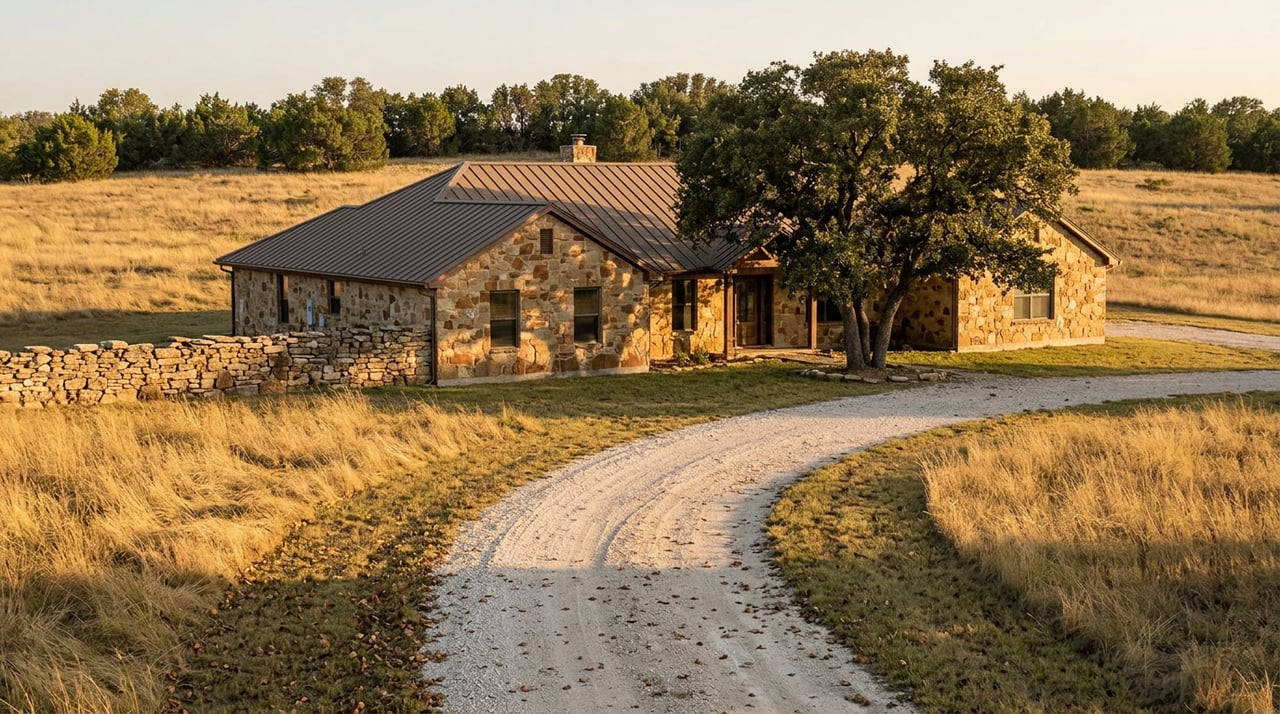
None of those numbers describe a three-bedroom house on a town lot. They describe acreage, and acreage in this part of Texas comes in a wide range of packages. A 293-acre property called Chappell Creek Ranch, held by the same family for roughly fifty years before hitting the market, was priced at $2,178,455 with over a mile of creek frontage. A high-fenced 3,450-acre property known as Lakeview Ranch sits about 15 minutes northwest of town. Burton Ranch runs 1,593 acres with 181 feet of elevation change across its hills. On the smaller end, a 160-acre property called Royal King Ranch near Sipe Springs has stayed in the same family for generations and is marketed as cattle and recreational ground rather than a subdivision play.
At the far end sits Comanche Star Ranch, a roughly 4,222-acre high-fenced operation built around eight managed trophy lakes, and Naylor Comanche Ranch, a 368-acre hunting property stocked with fallow deer, blackbuck antelope, and other exotic species alongside a 9,128-square-foot main lodge. These are the properties setting the top of that $1.15M to $6M range. They have almost nothing in common with the $191,000 to $418,000 range describing a home inside town.
Why the Blend Happens
Search engines and portal algorithms do not sort by intent. They sort by geography. Type "Comanche" into a real estate search and you get everything tagged with that name: town homes, farms on the edge of the county, and multi-thousand-acre exotic game ranches, all folded into the same results page and often the same summary statistic.
That is useful if you already know which market you are shopping. It is a trap if you don't. A Fort Worth buyer comparing "Comanche" to a handful of other small Texas towns, using whatever headline price the first search result shows, may be comparing an average that is three-quarters land and ranch data to another town's average that is almost entirely in-town homes. The comparison feels apples to apples. It isn't.
Reading a Comanche Listing Like You Know the Difference
A few habits separate a buyer who understands this market from one who is about to get surprised.
- Check the acreage before the price. A listing under half an acre is competing with the $191K to $418K in-town range. A listing over 20 acres is competing with the county's land and ranch pricing, which runs on a completely different scale.
- Ask whether the price is quoted as a total or per acre. Ranch listings usually lead with total price, which makes a 1,500-acre property with a modest per-acre cost look far more expensive at a glance than it actually is relative to size.
- Look for the exact acreage figure, not just the round number in the headline. A listing sized suspiciously close to a common ag-exemption threshold, like 10.01 acres, tells you the seller structured the parcel around the tax rule rather than around any particular use. That is not a red flag, but it is worth knowing before you fence it, since Comanche Central Appraisal District's own guidelines describe a rollback recapture covering the three years before a change in use if the land stops qualifying for agricultural valuation.
- Separate "Comanche the town" from "Comanche County" in your own head before you start comparing numbers to any other market. They are not interchangeable, even though most search results treat them that way.
What This Actually Means for a Buyer
If your budget is in the $200,000 to $450,000 range, you are shopping the in-town Comanche market, and the county's land and ranch averages are irrelevant to what you will actually pay. If your budget starts north of a million dollars, you are shopping the ranch layer, and a per-acre comparison across a few specific properties will tell you far more than any blended average ever could. The mistake worth avoiding is treating the single number that shows up first in a search as a description of one market, when it is actually an average of three.
FAQ
Is Comanche's housing market rising or falling right now? The most recent in-town figure, Foreclosure.com's median home value as of July 2026, showed values up close to 12 percent year over year. That reflects the town-only housing stock, not the ranch and acreage side of the county, which moves on a different cycle tied to per-acre demand rather than square footage.
Why do so many land listings in Comanche County sit at 10.01 acres instead of a round number? Texas ag-exemption rules vary by county, but the size that shows up most often across statewide guides is a minimum of 10 to 15 acres for a standard grazing operation. Landing just over 10 acres gives a buyer margin to qualify for agricultural valuation rather than paying full market-value property taxes on the parcel.
Does buying a small acreage tract with an ag exemption already in place guarantee I'll keep it? No. Comanche County's appraisal district requires the land remain in current and principal agricultural use, and a change in use can trigger a rollback that recaptures taxes for the three years before the change. Anyone buying a small-acreage tract specifically for the tax benefit should plan to maintain the qualifying use, not just inherit the paperwork.
If you're trying to figure out which Comanche market actually fits your budget, or want a straight read on what a specific acreage tract is really worth per acre before you make an offer, Ridge Tex Realty works this county every week and can walk you through it directly.